One of the most useful technologies of our day is artificial intelligence. Time is saved, workflows are automated, judgments are improved, and innovation is made possible across all industries. However, at the same time, cyberattacks, data breaches, privacy issues, and digital risks are also rising rapidly.
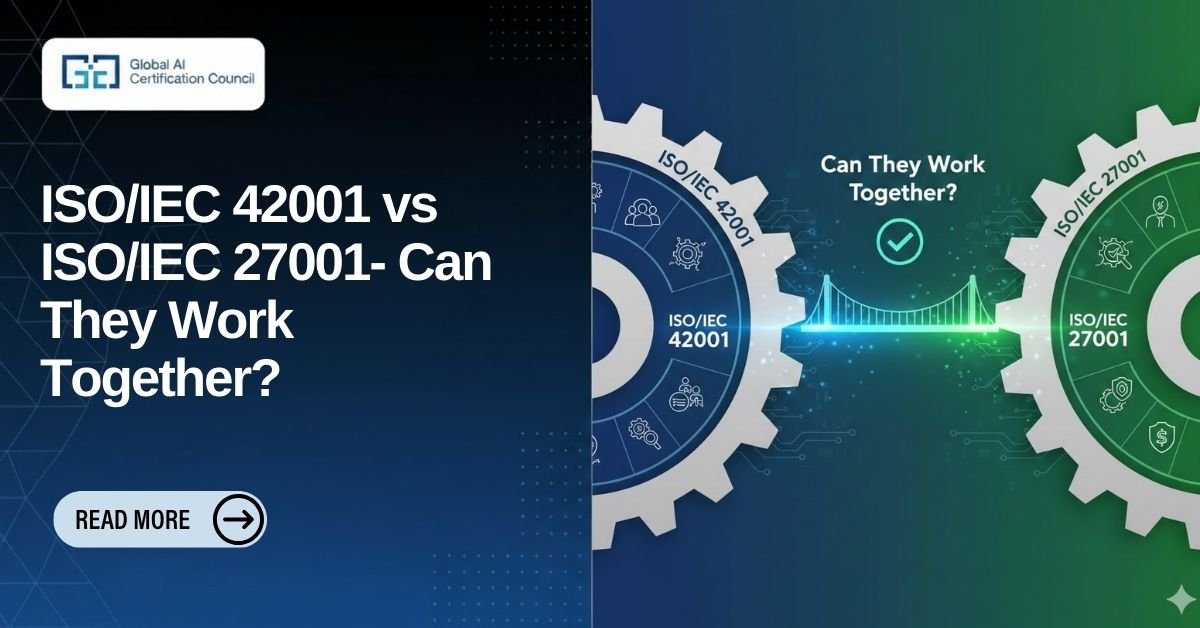
So it’s no wonder that firms everywhere are asking the same question: “We already protect our information using ISO/IEC 27001. Do we still require ISO/IEC 42001 now that AI is being used? Can both standards work together, or are they competing frameworks?”
In a nutshell, the standards essentially assist one another rather than clashing or hindering each other’s functions.
While ISO/IEC 27001 helps businesses protect information, ISO/IEC 42001 helps enterprises ensure that AI operates safely, ethically, and responsibly. When these two standards are combined, they provide a comprehensive protection concept for the AI era.
Here, we will take a look at both standards, their differences, how they come together to work efficiently, and why adopting both may soon become the global norm.
What is ISO/IEC 42001?
ISO/IEC 42001 is the first worldwide standard for establishing, implementing, maintaining, and enhancing an Artificial Intelligence Management System (AIMS). If ISO/IEC 27001 is the information security standard, then ISO/IEC 42001 is the responsible AI standard.
The standard aids businesses in ensuring that AI systems:
- Are safe and operate within permitted limitations
- Avoid discrimination and biased results.
- They are understandable and transparent.
- Can be audited and corrected by people
- Comply with societal, legal, and ethical standards
Precisely for this very reason, you can also find self-paced ISO/IEC 42001 courses that you can pursue to help your businesses function better.
In simple words, ISO/IEC 42001 answers: “How do we make sure AI creates value without creating harm?”
Why ISO/IEC 42001 was needed
It is important to understand that though AI is strong, it is not flawless. Some of the issues that can happen with AI include:
- Increase discrimination in the absence of governance
- Cause financial or physical harm
- Generate deceptive outcomes
- Gather or handle personal information carelessly
- Be abused, whether by purpose or accidentally
Before ISO/IEC 42001 came into play, there was no global standard advising organizations how to handle these risks consistently. The standard is a reaction to worldwide concerns about trust, transparency, safety, and accountability in AI deployment.
What ISO/IEC 42001 requires organizations to do
When it comes to organizations using ISO/IEC 42001, they must remember the following aspects:
- Identify AI-specific hazards
- Establish AI principles and objectives
- Describe duties and supervision.
- Preserve traceability and documentation for AI
- Track and assess the effects of AI at every stage of its development.
- Make constant improvements to their AI governance framework.
This guarantees that AI is responsible, equitable, and safe in addition to being technically powerful.
What is ISO/IEC 27001?
ISO/IEC 27001 is the international standard for Information Security Management Systems (ISMS). One of the main purposes of the standard is to help organizations protect the confidentiality, integrity, and availability of information. This information could be in any form, including digital, printed, spoken, stored in the cloud, or kept on paper.
Why ISO/IEC 27001 exists
Information is the foundation of all modern businesses. However, if this information becomes compromised, the repercussions could be dire. This could include issues like:
- Losses in money
- Fines for regulations
- Reputational damage
- Operational disruption
The ISO/IEC 27001 standard presents businesses with an organized strategy to:
- Evaluate the dangers to information security
- Apply cybersecurity controls
- Recognize and address risks
- Prevent misuse and loss of data
- Maintain smooth functioning even in times of emergency.
What ISO/IEC 27001 requires organizations to do
When it comes to aligning with the needs of the ISO/IEC 27001, businesses need to keep in mind certain aspects. This includes:
- Assess risks to information assets
- Put security measures in place.
- Monitor occurrences and vulnerabilities
- Protect against cyberattacks and human error
- Continue to improve
ISO/IEC 27001 is not optional anymore in many sectors; it is often a must for doing business, especially where customer or sensitive data is involved.
Similarities between ISO/IEC 42001 and ISO/IEC 27001
While they address different concerns, the two standards are designed on a similar basis. That’s why integration is not only conceivable, it’s quite practical.
Both follow the PDCA cycle.
Both demand that businesses:
- Plan: create goals, policies, responsibilities, and processes
- Do: Put controls in place and handle hazards
- Check: keep an eye on performance, audit findings, and evaluate
- Act: address issues and improve continuously
Because of this, combining both standards into a single management system is simple.
Both are risk-based
The concept behind both standards is simple: detect risks before they become events.
| Standard | Type of risk |
|---|---|
| ISO/IEC 42001 | Ethical, operational, societal, legal, and misuse risks related to AI |
| ISO/IEC 27001 | Cybersecurity and information security risks |
Both demand strong governance
To gain certification, firms must keep a few things in mind. This includes:
- Having top-management commitment
- Assigning oversight responsibility
- Maintaining documents and evidence
- Monitoring performance and reports regularly
Adopting both standards doesn’t require enterprises to change their governance approach because of this common foundation.
Key differences: AI governance vs information security
Even though the foundations are similar, the purpose and scope of each standard are distinct.
Here is a look at how the standards differ from each other.
| Aspects | ISO/IEC 42001 | ISO/IEC 27001 |
|---|---|---|
| Primary Purpose | Oversees the responsible development, application, and use of AI | Shield data against abuse and security risks. |
| Main Focus | Transparency, justice, safety, human oversight, and ethical AI | Confidentiality, integrity, and availability of information |
| Risk Type Managed | AI harm risks include prejudice, discrimination, false information, abuse, and safety lapses. | Information security threats like cyberattacks, data breaches, illegal access, and unintentional loss |
| Governance Scope | AI systems across the full lifecycle (design → training → testing → deployment → monitoring → retirement) | All information assets — digital, cloud, physical, and spoken |
| Controls Emphasis | Explainability, traceability, human accountability, impact monitoring, and AI ethics | Access control, encryption, backups, threat monitoring, and incident response |
| Who Benefits Most | Businesses creating, implementing, or utilizing AI systems | Any organization that stores, processes, or exchanges information |
| Example Questions: It Answers | “Can AI decisions be explained and justified?” “Is AI fair and safe for all users?” | "Who has access to this data?" "How can we prevent cyberattacks and data breaches?" |
| The outcome of Certification | Demonstrates responsible and reliable AI governance | Demonstrates strong and reliable information security |
| Failure Risk If Not Implemented | Unsafe AI results, legal/AI regulation non-compliance, ethical harm, and reputational harm | Financial loss, regulatory penalties, consumer trust loss, and business interruption |
The standards address distinct issues, yet those issues are related. Here is a simple example:
- AI may produce unfair results if it uses biased data.
- AI may have negative or disastrous effects if it uses data that has been altered.
- If AI spills personal data, the organization faces legal and ethical problems.
Without information security, AI governance is ineffective. Modern enterprises are not protected by information security without AI governance.
If you also want clarity on how these standards shape career paths, role expectations, and professional responsibilities, you can read our in depth guide on ISO IEC 42001 vs ISO IEC 27001 and why the comparison matters for professionals.
Can ISO/IEC 42001 and ISO/IEC 27001 work together?
ISO/IEC 42001 and ISO/IEC 27001 operate very well together, especially in the era of AI.
You see, while AI systems depend on secure data, secure systems now depend on trustworthy AI. These two standards together provide a comprehensive protection model for this very purpose.
Benefits of integrating both standards
Organizations that adopt both standards gain:
- Responsible AI: fair, safe, responsible, transparent
- Secure information: shielded from theft, misuse, and attacks
- Regulatory confidence: simpler compliance with AI and privacy regulations
- Higher customer trust: people choose firms that utilize AI properly and preserve their data
- Competitive advantage: contract bids, B2B deals, and collaborations increasingly require evidence of both security and responsible AI
Why is integration efficient?
Instead of running two distinct management systems side-by-side, with the help of the two standards put together, firms can:
- Combine governance and oversight
- Integrate internal audits.
- Combine plans for ongoing improvement
- Use a single set of policies if possible
- Use one risk register for both AI and information security
With less work, this provides companies with more robust protection.
Practical roadmap for organizations
When it comes to accommodating the two standards together, here are two scenarios that businesses look into.
1. If you are already certified in ISO/IEC 27001
The good thing in this scenario is that you’re already halfway ready for ISO/IEC 42001.
Here is a step-by-step breakdown of what you need to do next:
- Determine which areas of the company use AI
- Evaluate the risks associated with AI
- Incorporate AI governance duties into current governance positions.
- Revise protocols for AI system certification and monitoring
- Include ISO/IEC 42001 documentation requirements and controls.
- Expand internal audits to cover AI governance
With this process, businesses will be able to grow without friction.
2. If you don’t have ISO/IEC 27001 yet
Even if you don’t have ISO/IEC 27001, you can still begin with ISO/IEC 42001. Here is the breakdown for you in this scenario:
- Build responsible AI governance
- Establish lifecycle controls and risk management for AI
- When necessary, add information-security controls.
- Later, combine the two systems to create a single management system.
While both methods will work well, what matters is thinking strategically, not hurrying.
The business case: why this matters right now
Digital transformation and AI are advancing more quickly than laws. Organizations that wait for regulations to mandate compliance may already be behind.
Government regulations are getting stricter.
Laws and frameworks for AI governance are being introduced by nations and unions. Organizations may soon have to demonstrate responsible AI, not simply assert it.
ISO/IEC 42001 offers a universally accepted technique to do that.
Customers want trustworthy technology
People are interested in various aspects of AI. This includes:
- AI decision-making
- Whether AI is fair
- Whether the data is safe
- Whether AI is supervised or allowed to function independently
Compared to marketing claims, certifications enhance brand confidence considerably more consistently.
Investors are watching how AI is used.
Responsible AI is becoming part of ESG and due diligence. Organizations that handle AI risks are more attractive and more stable.
Employees want clarity, too.o
AI has an impact on the workforce as well as consumers. Standards assist firms in answering employee inquiries like:
- What are the limits of artificial intelligence in the workplace?
- Will decisions made by AI be observed?
- Is there transparency when AI judges performance?
- Strong governance protects both workers and employers.
Final takeaway
It is important to realize that ISO/IEC 42001 and ISO/IEC 27001 are not alternatives. In fact, they are complementary instruments for the digital era. While the ISO/IEC 27001 protects information and digital assets, ISO/IEC 42001 assures AI handles people fairly, ethically, and safely.
Together, the two standards offer:
- Operational dependability
- Ethical responsibility
- Safety and confidence
- Improved business continuity
- A professional image that is future-proof
Thus, to answer the question, “Which is better, ISO/IEC 42001 or ISO/IEC 27001?”
The fact is that they solve different problems, and the strongest organizations use both.
If you are looking to build deeper expertise in AI governance and learn how to implement an AIMS in real organisations, you can explore our self-paced ISO IEC 42001 training courses at GAICC.