Artificial intelligence has moved beyond the experimental phase and has now started influencing the decision-making process in various sectors. This can include sectors like healthcare, finance, recruitment, law enforcement, and public services. With the increase in AI utilization, the demand for robust governance also increases.
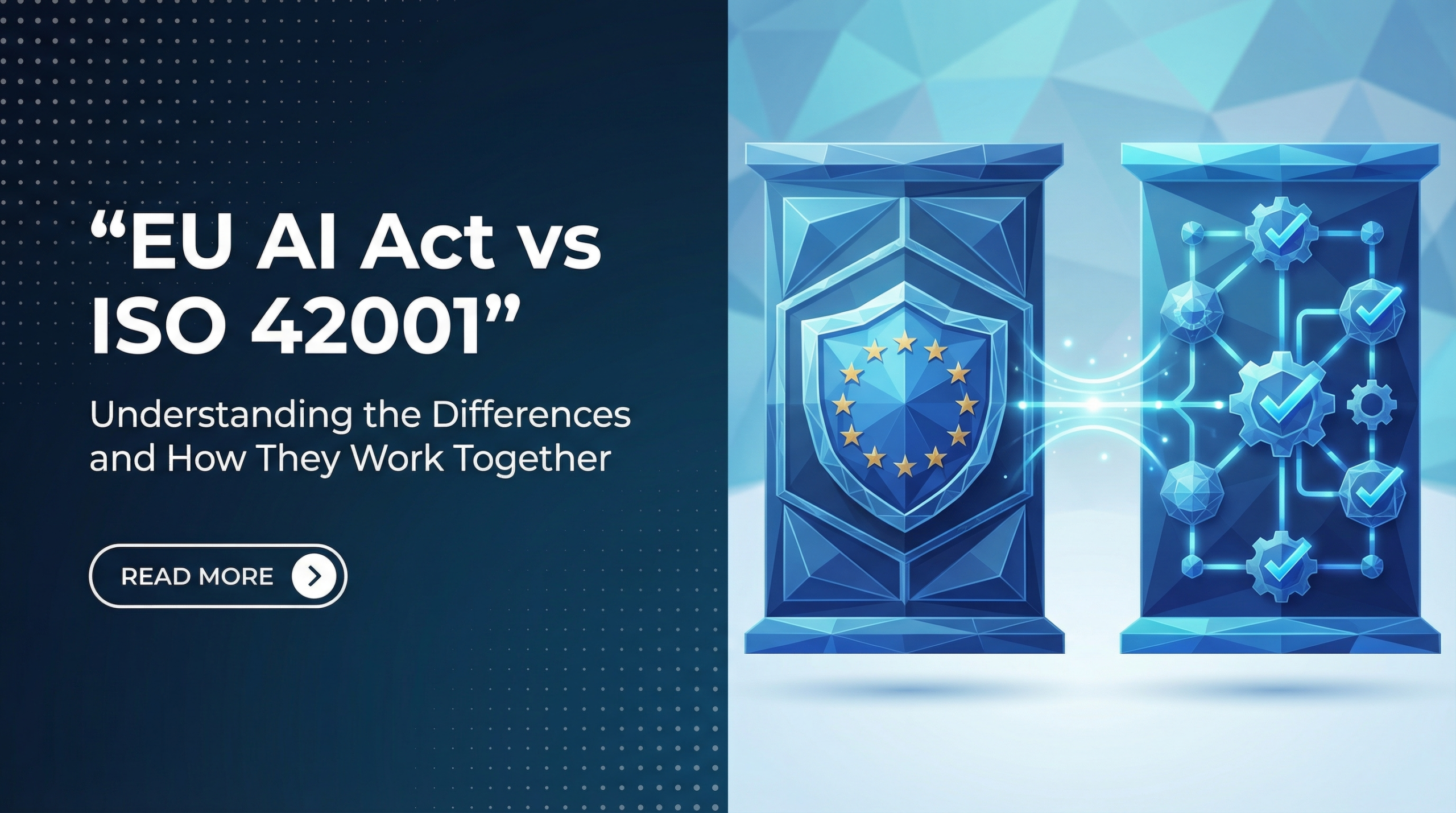
This is where the necessity of the EU AI Act versus ISO 42001 debate comes into the picture.
Both these frameworks look to enhance AI safety, transparency, and trustworthiness. However, they function in vastly different ways. While one is a constitutive regulation, the alternative is a worldwide management standard. It can get confusing for beginners to figure out how they relate, where they intersect, and if one substitutes the other.
Here, we will look into all concepts related to the frameworks to help you understand which standard to use where.
Why AI Governance Matters More Than Ever
The concept of AI governance hasn’t been more important than it is now. AI systems can influence various aspects like:
- Who qualifies for a loan
- Who is selected for a job interview
- How health risks are evaluated
- The manner in which public services are provided.
When AI fails, the consequences can be quite significant. Prejudice, absence of clarity, improper use of data, and hazardous automation pose genuine threats during such a time.
As a result, governments and global organizations are establishing regulations and benchmarks. Two of the key factors are:
- The EU Artificial Intelligence Regulation
- ISO/IEC 42001
Comprehending the EU AI Act in relation to ISO 42001 can help organizations in making more informed compliance and governance choices.
Understanding the EU AI Act
The EU AI Act is the world’s first comprehensive law focused entirely on artificial intelligence.
It is a binding regulation passed by the European Union. Once applicable, it carries legal obligations and penalties.
If you are looking for a simplified introduction to the Act’s objectives, scope, and risk categories, it is helpful to start with a beginner’s guide to the EU AI Act before diving into comparison analysis.
What Is the Purpose of the EU AI Act?
The EU AI Act is the first extensive legislation globally that concentrates solely on artificial intelligence.
It is a compulsory regulation enacted by the European Union. When it applies, it entails legal responsibilities and consequences.
The EU AI Act aims to:
- Safeguard basic rights
- Enhance AI security
- Enhance clarity
- Minimize detrimental or immoral AI applications
- Build confidence in AI technologies.
It is important to understand that the regulation is applicable not only to companies within the EU but also to any entity that offers AI systems in the EU market or utilizes them in the EU.
The Risk-Based Structure of the EU AI Act
A key characteristic of the EU AI Act is its approach based on risk.
AI systems can be classified into four distinct categories:
Unacceptable Risk
These are the AI systems that are completely prohibited.
Some examples include:
- Government social scoring using AI technology
- Specific types of immediate biometric monitoring
These applications are viewed as a direct danger to rights and freedoms.
High-Risk AI Systems
These systems are allowed, but heavily regulated.
Examples include AI used in:
- Recruitment and hiring
- Creditworthiness assessments
- Medical devices
- Education and exams
- Law enforcement and border control
High-risk systems are expected to meet strict requirements before they can be used.
Limited Risk
These AI systems are expected to provide transparency.
For example:
- Chatbots are required to inform users that they are engaging with artificial intelligence.
- Deepfakes need to be distinctly marked
Minimal Risk
The majority of common AI tools fit into this category.
Some of the examples include:
- Artificial intelligence in gaming
- Junk email filters
- Image improvement tools
These systems encounter minimal or no oversight.
Key Obligations Under the EU AI Act
For AI systems classified as high-risk, the EU AI Act mandates:
- Systems for managing risk
- Top-notch training data
- Technical documentation
- Human supervision
- Precision, resilience, and cybersecurity measures
- Maintaining records and documentation
- Surveillance after market release
Failure to comply with these mandates may result in hefty penalties, including a portion of annual global revenue for an organization.
What Is ISO/IEC 42001?
ISO/IEC 42001 is the first global standard for AI management systems. It was released by ISO and IEC, the same entities responsible for ISO 27001 and ISO 9001.
It is important to remember that in contrast to the EU AI Act, ISO 42001 is not legislation
The Purpose of ISO 42001
ISO 42001 provides an organized approach to various aspects in the AI world. This includes:
- Managing AI in a responsible manner.
- Handling risks associated with AI
- Guaranteeing responsible usage
- Enhancing clarity and responsibility.
- Synchronizing AI with company principles
This framework is relevant to any organization, in any nation, across any industry.
How ISO 42001 Works
ISO 42001 adheres to the well-known management system framework centered on ongoing enhancement.
It encompasses:
- Guidelines and goals for AI
- Established functions and duties
- Processes for evaluating risk
- Regulations for data, models, and implementation
- Oversight and internal evaluations
- Ongoing enhancement processes
Accredited certification bodies can certify organisations in accordance with ISO 42001.
Professionals seeking structured learning and certification pathways can explore formal ISO/IEC 42001 Certification Courses to build governance expertise.
Where the EU AI Act and ISO 42001 Align
Despite their differences, there is meaningful overlap between the two.
This overlap is one reason why ISO 42001 is often seen as a strong foundation for EU AI Act compliance.
Shared Principles
Both the frameworks talk about certain aspects like:
- Risk-based thinking
- Transparency and documentation
- Human oversight
- Accountability
- Data governance
- Lifecycle management of AI systems
Studies and industry analysis suggest around 40–50% conceptual overlap between the requirements of the EU AI Act and ISO 42001.
Risk Management as a Common Core
Both frameworks require organisations to help:
- Identify AI risks
- Assess impact
- Apply controls
- Monitor outcomes over time
ISO 42001 provides the structure while the EU AI Act defines the legal thresholds.
For a practical breakdown of how deployers must implement monitoring, documentation, and oversight controls, a practical guide for EU AI Act deployers can provide step-by-step clarity.
Key Differences: EU AI Act vs ISO 42001
Here is where it can get a bit confusing for people and organizations. Here is a breakdown of the differences that exist between the EU AI Act and the ISO 42001 frameworks.
Legal Status
While the EU AI Act is binding regulation with legal force where compliance is mandatory, the ISO 42001 is a voluntary international standard where adoption is optional.
This is literally the most important distinction in the EU AI Act vs ISO 42001 comparison.
Geographic Scope
The EU AI Act applies to AI systems placed on or used in the EU, regardless of where the organisation is based. The ISO 42001, on the other hand, is global in scope. It applies wherever an organisation chooses to adopt it.
Focus and Design
While the EU AI Act is prescriptive and rule-based and tells organisations what must be done, the ISO 42001 is principle-based and flexible and informs organisations how to build governance systems.
Prohibitions
The EU AI Act explicitly bans certain AI practices but the ISO 42001 does not ban AI uses but focuses on responsible management instead.
Enforcement and Penalties
The EU AI Act includes strong enforcement mechanisms and fines. The ISO 42001, on the other hand, has no legal penalties. Non-compliance only affects certification status.
How ISO 42001 Supports EU AI Act Compliance
Numerous organizations are opting to adopt ISO 42001 as a foundational governance framework.
Here’s the reason.
Practical Benefits
ISO 42001 assists organizations:
- Establish responsibilities and accountability for AI roles.
- Develop risk registers.
- Keep records.
- Evaluate AI performance
- Implement internal regulations
- Get ready for evaluations
These components directly assist in fulfilling EU AI Act requirements, particularly for high-risk AI systems.
Not a Replacement, but a Companion
There are a few things that are very important to keep in mind when it comes to the two frameworks. This includes knowing that:
- ISO 42001 does not replace the EU AI Act
- ISO certification does not guarantee legal compliance
But together, they form a powerful combination. This is exactly why discussions around EU AI Act vs ISO 42001 increasingly focus on integration rather than choice.
Common Misunderstandings to Avoid
Let’s dispel some common misconceptions when it comes to the two frameworks.
- ISO 42001 is not a regulation of the EU.
- Compliance with the EU AI Act is mandatory.
- Certification does not eliminate legal accountability.
- A single framework is seldom adequate for intricate AI applications.
Grasping these aspects prevents expensive errors.
Final Thoughts: Choosing the Right Path
AI governance has become a practical reality. It is strategic, operational, and legal. The comparison between the EU AI Act and ISO 42001 is not about selecting a side. It is more about understanding the specific roles of the frameworks.
While the EU AI Act establishes legal limits, ISO 42001 establishes a framework for governance. When combined, they assist organizations to minimize danger, enhance reliability, get ready for inspections and the responsible scaling of AI.
For newcomers, the main point is straightforward: Law establishes what is required of you and the standards assist you in determining the best way to achieve it