
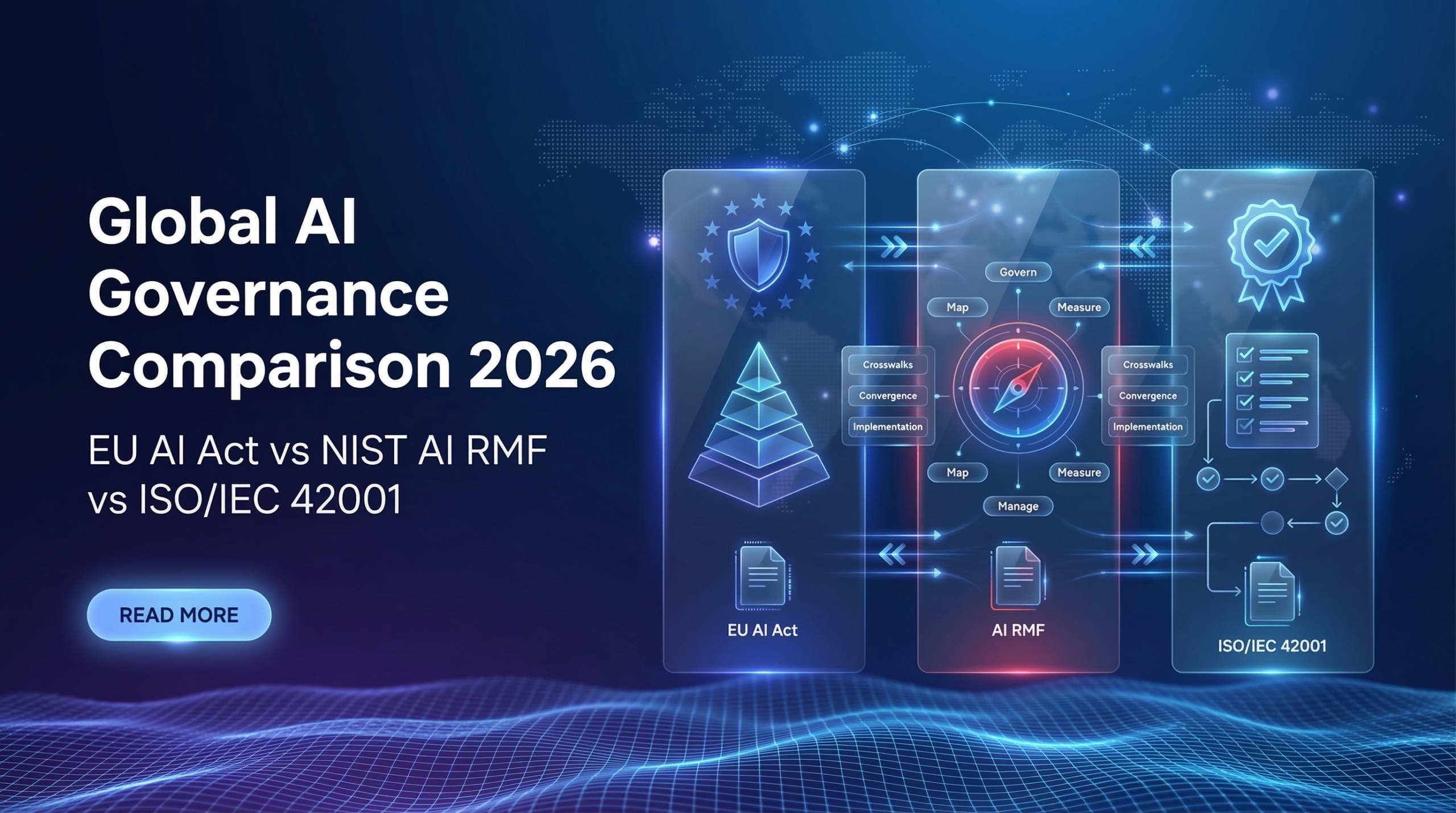
This comparison breaks down what each framework actually requires, where they overlap, where they diverge, and how to implement them efficiently as a unified governance programme rather than three separate compliance exercises.
Three Frameworks, Three Different Problems
EU AI Act
Answers: What is legally required?
Binding law. Classifies AI by risk level, assigns obligations to providers and deployers, prohibits certain uses, and enforces with penalties up to €35M or 7% of global revenue. Mandatory for EU market operations.
NIST AI RMF
Answers: How should we manage AI risk?
Voluntary, sector-agnostic methodology. Four functions (Govern, Map, Measure, Manage) for identifying, assessing, and mitigating AI risks. Referenced by US federal agencies in enforcement and procurement.
ISO/IEC 42001
Answers: How do we prove governance works?
International standard for an AI Management System. Third-party certification provides externally verified evidence. Jurisdiction-neutral with crosswalks to both NIST and EU AI Act.
The distinction matters because organisations frequently treat these as competing options when they are complementary layers of a single governance stack. NIST provides the risk management methodology. ISO 42001 provides the auditable management system. The EU AI Act provides the legal compliance requirements. An organisation implementing all three has no duplicated effort if it uses the published crosswalks to align them.
The Master Comparison Table
| Dimension | EU AI Act | NIST AI RMF 1.0 | ISO/IEC 42001:2023 |
|---|---|---|---|
| Nature | Binding regulation (EU law) | Voluntary framework | Certifiable international standard |
| Origin | European Parliament & Council | US Dept of Commerce / NIST | ISO and IEC (Joint Technical Committee) |
| Released | Adopted May 2024, phased 2025-2027 | January 2023 (v1.0) | December 2023 |
| Geographic Scope | EU + extraterritorial | US-focused, globally referenced | Global |
| Primary Audience | AI providers, deployers, importers in EU | All organisations developing or deploying AI | Any organisation providing or using AI |
| Core Structure | Risk tiers: unacceptable, high, limited, minimal | Four functions: Govern, Map, Measure, Manage | ISO Clauses 4-10 + Annexes A, B, C, D |
| Certification | Conformity assessment for high-risk | No formal certification | Yes, third-party certification |
| Enforcement | Fines up to €35M or 7% global revenue | No direct enforcement | Market-driven (procurement, partnerships) |
| AI-Specific Controls | Prescriptive for high-risk (Articles 9-15) | Outcome-based with Playbook | Annex A controls + Annex B guidance |
| Generative AI | GPAI obligations (effective Aug 2025) | AI 600-1 Gen AI Profile (July 2024) | Via risk assessment (no gen AI annex) |
| Cybersecurity | Referenced through EU frameworks | Cyber AI Profile (IR 8596, Dec 2025) | Integrates with ISO 27001 |
| Crosswalks | Maps to NIST AI RMF and ISO 42001 | Official crosswalk to ISO 42001 | Official crosswalk to NIST AI RMF |
Deep Dive: The EU AI Act in 2026
The EU AI Act entered into force on 1 August 2024. Its obligations phase in on a timeline that makes 2026 the decisive compliance year.
February 2025: Prohibited AI practices banned (social scoring, untargeted facial recognition scraping, emotion recognition in workplaces and schools). AI literacy obligations begin for all providers and deployers.
August 2025: Governance infrastructure operational. General-purpose AI (GPAI) model obligations begin. Member States designate national competent authorities. AI Office, AI Board, and Scientific Panel operational.
August 2026: High-risk AI system rules (Annex III) take effect. Transparency obligations (Article 50) enforceable. Full enforcement begins at national and EU level. Member States must have at least one AI regulatory sandbox.
August 2027: High-risk AI systems embedded in regulated products (Annex I) must comply. Pre-August 2025 GPAI model providers must be fully compliant.
For US organisations, the extraterritorial reach is the critical consideration. Any company placing AI systems on the EU market or deploying AI within the EU must comply regardless of where the company is headquartered. Penalties reach €35 million or 7% of global annual turnover for prohibited practices, €15 million or 3% for other violations.
High-risk system obligations include: risk management systems throughout the lifecycle (Article 9), data governance practices (Article 10), technical documentation (Article 11), record-keeping and logging (Article 12), transparency and information provision to deployers (Article 13), human oversight measures (Article 14), and accuracy, robustness and cybersecurity requirements (Article 15).
If you need a more practical overview of scope, obligations, timelines, and business impact, see our EU AI Act Beginner’s Guide to AI Regulation and Business Compliance.
Deep Dive: NIST AI RMF and Its Expanding Ecosystem
The NIST AI RMF 1.0 (NIST AI 100-1), released January 2023, established the foundational architecture: four interconnected functions that organise all AI risk management activities.
Govern is the cross-cutting function establishing policies, accountability, risk tolerance, and organisational culture. It informs and is embedded within the other three functions.
Map identifies context, stakeholders, intended purposes, and potential impacts. It produces the contextual knowledge needed for go/no-go decisions on AI system development or deployment.
Measure employs quantitative and qualitative tools to assess risks including bias, explainability, security, and performance. It translates contextual understanding into measurable indicators.
Manage allocates resources to address risks, implements controls, establishes incident response, and maintains post-deployment monitoring with defined intervention triggers.
What has changed since 2023 is the ecosystem surrounding the core framework. The Generative AI Profile (AI 600-1, July 2024) identifies 12 risk categories specific to large language models and multimodal systems: confabulation, data privacy, environmental impact, information integrity, intellectual property, toxic content, and six others. The Cyber AI Profile (IR 8596, preliminary draft December 2025) bridges AI risk management with the Cybersecurity Framework 2.0 across three focus areas: securing AI systems, using AI for cyber defence, and defending against AI-enabled threats. The SP 800-53 Control Overlays for Securing AI Systems (COSAiS, concept paper August 2025) provide implementation-level controls.
The NIST AI RMF does not have formal certification. It is voluntary. But its influence exceeds its voluntary status. The FTC, CFPB, FDA, SEC, EEOC, and Department of Defense all reference its principles. Federal procurement increasingly expects NIST alignment. Enterprise customers use it as the benchmark for evaluating vendor AI governance maturity.
For a deeper breakdown of the four core functions, the Generative AI Profile, and the Cyber AI Profile, read our full guide to the NIST AI Risk Management Framework.
Deep Dive: ISO/IEC 42001 as the Certification Layer
ISO/IEC 42001:2023 is the first international standard specifying requirements for an AI Management System (AIMS). It uses the ISO Harmonized Structure shared with ISO 27001 (information security) and ISO 9001 (quality management), making it integrable with existing management systems.
The standard’s core requirements span Clauses 4 through 10: understanding organisational context and stakeholder needs (Clause 4), leadership commitment and AI policy (Clause 5), planning including risk assessment and AI impact assessment (Clause 6), resources, competence, and awareness (Clause 7), operational planning and control (Clause 8), performance evaluation and monitoring (Clause 9), and nonconformity handling and continuous improvement (Clause 10).
Annex A provides reference control objectives and controls covering AI policy, internal organisation, resources, AI system lifecycle, data, information for interested parties, use of AI systems, and third-party relationships. Annex B provides implementation guidance. Annex C maps organisational objectives. Annex D provides domain-specific guidance.
The certification advantage is straightforward: it provides externally verified, auditable evidence that your AI governance meets international benchmarks. NIST alignment can be claimed by any organisation; ISO 42001 certification is verified by accredited third parties. Microsoft and other major technology companies have obtained certification. India’s Bureau of Indian Standards has adopted it nationally. Singapore has mapped AI Verify to its controls. Enterprise procurement processes increasingly list ISO 42001 in due diligence questionnaires.
To understand how certification strengthens governance maturity across jurisdictions, explore our guide on how ISO/IEC 42001 strengthens AI governance and compliance frameworks.
Where the Three Frameworks Converge
The published crosswalks reveal substantial overlap. Understanding these convergence points is essential for efficient implementation.
| Governance Area | EU AI Act | NIST AI RMF | ISO/IEC 42001 |
|---|---|---|---|
| System context | Article 1 | Govern 1.1-1.4 | Clause 4.1, 6.2 |
| Risk assessment | Articles 9, 27 | Govern 1.4-1.5, Map 1-5 | Clause 6.1, 8.2-8.3 |
| Data governance | Article 10 | Map 2.3, Manage 1.1 | Annex A.5 |
| Documentation | Articles 11, 18 | Govern 1.4, Map 5 | Clause 7.5, Annex A.6 |
| Human oversight | Article 14 | Govern 1.3, Manage 3 | Annex B.7 |
| Transparency | Articles 13, 50 | Govern 1.4, Map 1.3 | Annex A.6 |
| Monitoring | Article 89 | Measure 4.2, Govern 2.1 | Clause 9.1 |
| Incident management | Article 73 | Govern 4.3, Manage 4 | Annex A, Control 8.4 |
| Supply chain | Articles 25-28 | Govern 6, Manage 2.4 | Annex A.8 |
| Continuous improvement | Article 17 | Iterative cycle design | Clause 10 |
The convergence means an organisation building its governance programme thoughtfully can satisfy all three frameworks with a single set of processes, policies, and documentation. Start with ISO 42001’s management system structure, use NIST AI RMF’s functions for risk management methodology, and layer EU AI Act’s prescriptive obligations for high-risk systems.
Where They Diverge: Critical Differences
Enforcement and Consequences
The EU AI Act is law with financial penalties. NIST AI RMF is voluntary guidance that regulators reference but do not enforce directly. ISO 42001 is market-driven: losing certification can mean losing contracts, but there are no regulatory penalties for non-certification.
Prescriptiveness
The EU AI Act prescribes specific requirements for high-risk systems (risk management, data governance, documentation, logging, transparency, human oversight, accuracy, robustness, cybersecurity). NIST AI RMF defines outcomes but lets organisations decide how to achieve them. ISO 42001 requires documented management system processes but allows flexibility in Annex A control selection.
Generative AI Specificity
The EU AI Act has GPAI model obligations with transparency, safety, and copyright requirements. NIST AI RMF has a dedicated Generative AI Profile (AI 600-1) with 12 risk categories. ISO 42001 does not have a generative AI-specific annex; coverage comes through the standard’s risk and impact assessment processes.
Assessment and Verification
The EU AI Act requires conformity assessment for high-risk systems (self-assessment or third-party depending on category). NIST AI RMF has no formal assessment process. ISO 42001 offers third-party certification through accredited bodies following a two-stage audit.
Agentic AI Coverage
None of the three frameworks was designed for agentic AI. Singapore’s January 2026 framework is the only governance document addressing autonomous agents directly. Organisations deploying agents must extend these frameworks to cover cascading failures, scope creep, and attribution gaps.
The Practical Implementation Sequence
Organisations facing all three frameworks often ask: where do we start? The optimal sequence depends on regulatory exposure, market requirements, and current governance maturity. Here is the recommended approach for most US organisations with international operations.
Start with NIST AI RMF
It provides the most flexible starting point and strongest US-specific utility. Implement the four functions (Govern, Map, Measure, Manage) across your AI portfolio. Use the Playbook for practical guidance. This establishes your risk management methodology and creates the foundation everything else builds on.
3-6 months
Build toward ISO 42001 Certification
Use the official NIST-ISO crosswalk to map your implementation to ISO 42001 clauses. The incremental work is primarily formalising documentation, establishing management review processes, conducting internal audits, and building an evidence repository. Certification provides the externally verified credential that enterprise customers and partners require.
2-4 months additional
Layer EU AI Act Compliance
If you have EU exposure, use the three-way crosswalk to identify where EU AI Act obligations exceed what NIST and ISO already cover. Primary additions: risk classification under four-tier model, conformity assessment for high-risk systems, CE marking and EU database registration, EU authorised representative appointment, and GPAI transparency obligations.
2-4 months additional
This sequence works because each layer builds on the previous one. NIST provides methodology. ISO 42001 adds structure and evidence. The EU AI Act adds jurisdiction-specific legal requirements. The total implementation takes approximately 8 to 12 months for a moderately complex organisation.
Which Framework Matters Most for Your Organisation?
AI systems in the EU market
EU AI Act is legally binding. Start there for compliance, but use ISO 42001 and NIST as implementation tools. Certification demonstrates management system maturity regulators evaluate.
US-only with no EU exposure
Start with NIST AI RMF for risk management. Pursue ISO 42001 for competitive advantage in enterprise sales and government contracting. Watch state-level AI legislation.
Enterprise AI product or service vendor
ISO 42001 certification is moving from differentiator to table stakes. Procurement teams require evidence of formal AI management systems. Certification shortens sales cycles.
Federal contractor
NIST AI RMF alignment is expected. Layer ISO 42001 to demonstrate governance that survives external audit. The combination satisfies NIST expectations and broader maturity assessments.
Multi-jurisdictional operations
ISO 42001 is the common denominator. Jurisdiction-neutral with crosswalks to both NIST and EU AI Act. Adopted or mapped by India, Singapore, and Australia.
Regulated industry (finance, healthcare)
All three may apply. Sector regulators (OCC, FDA, CFPB) reference NIST. EU AI Act covers high-risk health and finance uses. ISO 42001 provides audit-ready governance for compliance teams.
Building the Unified Cross-Framework Register
The most efficient approach to multi-framework governance is maintaining a single cross-framework register documenting each AI system alongside its applicable requirements across all three frameworks.
For each AI system, the register should capture: the system name and purpose; its EU AI Act risk classification (unacceptable, high, limited, or minimal); which NIST AI RMF functions have been applied and to what depth; which ISO 42001 Annex A controls are in scope; the responsible owner and governance committee oversight status; current compliance status across all applicable frameworks; outstanding gaps and remediation timelines; and documentation and evidence locations.
This register serves triple duty: it satisfies ISO 42001’s Clause 8 requirements for operational planning, supports NIST AI RMF’s Map and Govern functions, and provides the system inventory required for EU AI Act compliance. Maintaining it as a living document with quarterly reviews ensures governance keeps pace with AI system changes.
The Unified Governance Advantage
The organisations that will navigate AI governance most effectively in 2026 and beyond are those that stop treating these frameworks as separate compliance projects. The EU AI Act, NIST AI RMF, and ISO 42001 form a single governance stack: regulation providing legal requirements, a framework providing risk management methodology, and a standard providing certifiable evidence.
The crosswalks exist. The convergence points are documented. The implementation sequence is clear. What remains is execution: building the governance infrastructure that satisfies regulators, earns certification, manages risk, and ensures your AI systems operate responsibly.
Ready to build your unified AI governance programme? Explore GAICC’s ISO/IEC 42001 certification programmes to add internationally recognised certification to your NIST AI RMF implementation and prepare for EU AI Act compliance.