Why AI Governance Needs a Global Standard for Responsible AI Systems
AI is changing every sector, including healthcare, education, finance, and defense. However, one concern continues coming up as businesses use AI systems more extensively: how can we make sure AI acts ethically and openly?
This is where the idea of AI governance comes to the fore. AI governance is a collection of guidelines, regulations, and accountability frameworks that guarantee the ethical, safe, and legal use of AI systems. Governance in AI addresses every aspect of data collection, algorithmic decision-making, and accountability in the event of an error.
Until recently, corporations were unable to manage these duties consistently due to the lack of a universal, certifiable standard. Here is a look at the different nations and authorities that have their own frameworks.
- The EU AI Act establishes stringent paperwork and monitoring requirements and categorizes AI systems according to risk levels.
- The U.S. developed the NIST AI Risk Management Framework, which encourages reliable AI through ongoing risk assessment and openness.
- The OECD AI Principles emphasize human-centered design, accountability, and fairness.
Although these initiatives are worthwhile, multinational corporations need a single, unified system that could link ethics, governance, and compliance. Thus, the first internationally recognized AI Management System Standard (AIMS) was brought out in the form of ISO/IEC 42001.
The ISO/IEC 42001 gives businesses an organized method for creating, implementing, and auditing ethical AI systems that comply with legal and ethical standards.
(Read more about the foundation of ISO/IEC 42001 in our master pillar blog.)
How ISO/IEC 42001 Aligns AI Governance Principles with Organizational Accountability
The ISO/IEC 42001 can help convert abstract AI ethics into quantifiable organizational actions, making it extremely influential. It establishes specific governance structures, procedures, and layers of accountability, making sure nothing is left to AI’s interpretation.
Here’s a look at how it connects real-world accountability with AI governance principles:
- Through Risk Control: Organizations need to identify, assess, and manage AI-related risks like bias, data leakage, or automation failures. This needs to be done in accordance with clause 6 of the ISO 42001 AI Standard.
- Defined Roles & Responsibilities: ISO/IEC 42001’s Clause 5 also requires companies to designate positions like AI Owner, Risk Officer, and Model Validator to guarantee that every phase of the AI lifecycle is always accountable.
- Ethics and Transparency: The framework also promotes aspects like explainability, fairness, and oversight policies. This helps teams in effectively communicating AI decisions to stakeholders.
- Continuous Review: To monitor and develop AI systems better throughout time, the framework has Clauses 9 and 10, which establish a loop for performance review and improvement.
Basically, ISO/IEC 42001 facilitates the practical application of AI governance. By putting it into practice, companies go from stating that “we believe in responsible AI” to providing auditable proof. You can also explore how ISO 42001 integrates governance into accountability frameworks in this GAICC article.
Bridging Global AI Compliance Frameworks: ISO/IEC 42001, EU AI Act, and NIST AI RMF
The ISO/IEC 42001 framework is designed to support international AI frameworks; it does not exist in a vacuum.
Here is a look at how it relates to the three most important international AI frameworks:
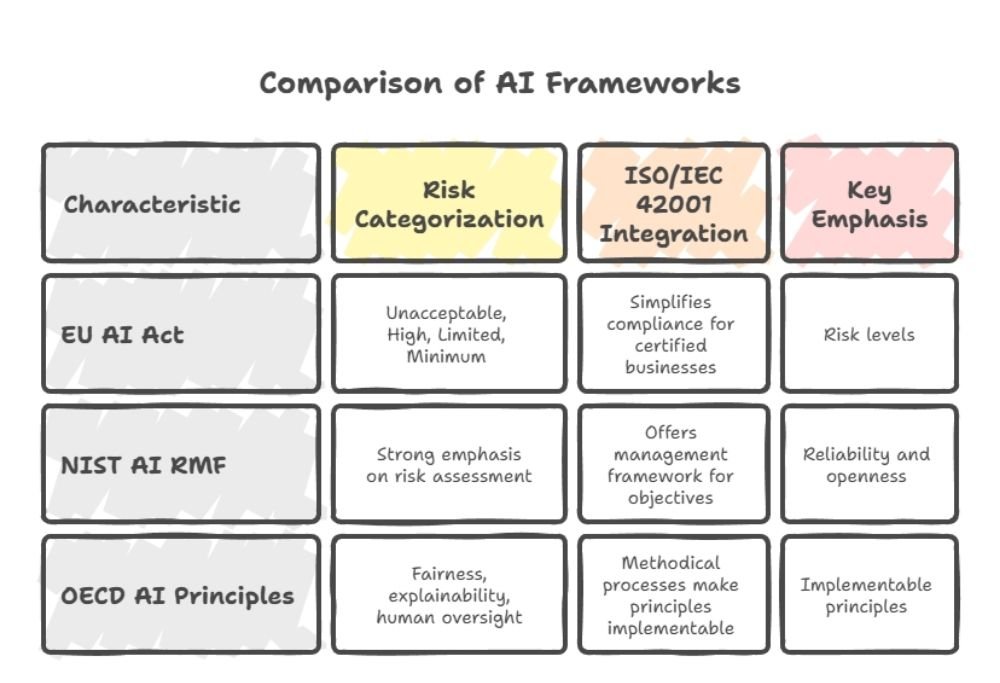
With an ISO 42001 AI Management System, a multinational corporation will be better able to show compliance with EU, U.S., and OECD standards in addition to ISO requirements, cutting down on duplication and audit time.
Implementing Effective AI Governance Using ISO/IEC 42001 Clauses and Controls
Converting the standard’s provisions into workable procedures is essential to successfully implementing AI governance.
Here is a four-step process that you can use to do this:
1. Policy Layer: Organizational Context, Clause 4
- Start by describing the data governance, transparency, and AI ethical policies of your company.
- Figure out who the internal and external stakeholders are. This could include compliance officers and data scientists.
- Keep a record of the goals and scope of your AI Management System (AIMS).
2. Process Layer: Planning and Risk Management, Clause 6
- It is important to create AI risk registers to identify any operational, ethical, and legal hazards.
- Next, create model documentation templates to document decision results, logic, and system inputs.
- Use explainability checklists to make sure transparency exists during audits.
3. The People Layer: Leadership and Responsibility, Clause 5
In this layer, you need to assign distinct duties in governance, like those of:
- AI Owner who is responsible for managing the accountability and lifecycle of AI.
- Risk Officer who is responsible for overseeing impact assessments
- Model Validator, who is responsible for guaranteeing the fairness, dependability, and technical integrity of the AI.
It is also important to remember to create internal channels of communication to promptly report problems or biased findings.
4. Performance Layer: Performance Evaluation, Clause 9
- Monitor KPIs for AI systems, including those of safety, accuracy, and fairness.
- Find potential shortcomings, conduct management reviews, and audits on a regular basis.
- Connect business value to performance metrics. This can be done by lowering fines under regulations, reducing the downtime of AI models, and increasing investor confidence and consumer trust.
Together, these layers transform AI Governance Standard ISO/IEC 42001 from a compliance document to a dynamic governance framework that changes as an organization’s AI capabilities advance.
Overcoming AI Governance Challenges Through ISO/IEC 42001 Integration
A report by IBM states that the oversight that the adoption of AI has brought on has increased the chances of attacks. This is why AI governance can be intimidating, particularly for businesses with numerous frameworks and international operations.
Here is a look at some of the most common challenges that ISO/IEC 42001 integration helps to overcome:
- Problem: Insufficient Accountability
- Resolution: Clause 5’s role-based accountability guarantees that everyone is aware of their responsibilities.
- Problem: Disconnected Policies Among Teams
- Resolution: Clause 4 of the framework, helps unify policies across departments by consolidating organizational context.
- Problem: Variations in Risk Evaluations
- Resolution: Clause 6, which helps introduce a systematic method for identifying and mitigating risks.
- Problem: Assessing AI Ethics
- Resolution: Clause 9, which has audit trails and compliance dashboards, performance measurements, and makes “responsible AI” measurable.
- Problem: Integration with Current Management Systems
- Resolution: The easy integration of the AI Governance Standard ISO/IEC 42001 into current ISO-certified frameworks, as it naturally aligns with other standards like ISO 9001 and ISO 27001.
By mapping these issues to particular clauses in ISO/IEC 42001, organizations can build a reliable, auditable AI ecosystem and improve the maturity of their AI governance.
Strategic and Measurable Benefits of ISO/IEC 42001 Certification for Organizations
AI Management System (AIMS) implementation and ISO/IEC 42001 certification provide observable, quantifiable results:
- Increased Openness and Trust
Thanks to the certification, clients, authorities, and the general public can better see that your AI systems are visible, understandable, and regularly checked for security and fairness. - Preparedness for Regulation
ISO/IEC 42001 Certification offers early compliance readiness, greatly reducing the cost of regulatory adaptation, as the EU AI Act, U.S. NIST RMF, and OECD Principles acquire international acceptance. - Synergy of Integration
The standard readily combines ISO 9001 and ISO 27001, thus enabling companies to handle data, security, and AI ethics under a unified governance framework. - Decreased Chance of Penalties and Noncompliance
The likelihood of AI-related mishaps, privacy violations, or noncompliance fines is decreased by ongoing monitoring and risk detection. - Increased Customer and Investor Trust
Demonstrating ISO 42001 compliance helps businesses draw in investors and clients who respect moral and trustworthy AI processes as AI responsibility becomes a board-level concern.
Future Outlook: The Expanding Role of ISO/IEC 42001 in AI Governance and Regulation
ISO/IEC 42001 is becoming more and more important to the future of AI regulation. A number of significant changes are anticipated between 2025 and 2030. This could include the OECD and EU officials using ISO/IEC 42001 as a global standard for risk management and AI compliance.
ISO 42001 certification may soon be accepted by governments as a component of legal compliance evaluations for AI systems. In line with the current need for ISO 27001 and GDPR specialists, AI compliance positions like AI Ethics Officer, AIMS Manager, and AI Risk Auditor are expected to grow significantly.
This opens up new employment opportunities for specialists in AI governance, ranging from implementers and auditors to consultants who assist businesses in navigating moral AI operations.
How GAICC Helps
GAICC is an ISO-approved AI training and certification organization, and it provides internationally renowned courses to advance your knowledge of AI governance. With GAICC, professionals can learn how to implement, audit, and manage AI systems utilizing the ISO 42001 framework by taking GAICC’s ISO/IEC 42001 courses.
Here are a few ways in which GAICC can help:
- Helps you obtain ISO-recognized certification and CPD credits that are valid worldwide.
- Prepares you for positions such as AIMS Implementer, Compliance Manager, or AI Governance Lead.
- Provides you access to practical toolkits, such as explainability checklists, risk registers, and audit templates.
GAICC’s organized learning path guarantees that you can develop, oversee, and certify AI systems in compliance with ISO 42001, regardless of your level of experience, right from Foundation to Senior Lead Implementer or Lead Auditor.
Final Takeaway: ISO/IEC 42001 as the Foundation for Trustworthy and Auditable AI Systems
Aspects like trust and responsibility are essential in a world where AI judgments impact people’s lives and industries. In this context, ISO/IEC 42001 is the first worldwide framework that helps make AI systems safe, transparent, and auditable.
With this in mind, organizations can close the gap between innovation and regulation by implementing this AI Management System (AIMS). They build a foundation for reliable, compliant, and future-ready AI by converting ethical AI concepts into organized, quantifiable, and business-aligned procedures.
References
- https://www.iso.org/standard/42001
- https://webstore.iec.ch/en/publication/90574
- https://learn.microsoft.com/en-us/compliance/regulatory/offering-iso-42001